People of Conshohocken – J.B Hillman
February 17, 2026
History of a House (s) 322 & 324 Fayette Street
February 23, 2026Black History Month – Reverend Marshall W. Lee

Black History Month
When I Think About Black History,
Reverend Marshall W. Lee is at the Top of My List
By Jack Coll
February 20, 2026
I started writing articles highlighting Black History Month nearly forty years ago in the Conshohocken Recorder. Over the years I’ve highlighted and “spot-lighted” many Conshohocken African American residents highlighting their contributions to Conshohocken and beyond.
As an avid cross-country traveler, I developed a devotion to visiting many “Civil Rights” monuments and landmarks throughout the South and across the country. I continue to be amazed at the courage shown by African-Americans, in their struggles as they sought to be able to vote, ride a bus, sit in a restaurant or go to school. These simple rights as an American that we so-much take for granted these days, the battles they fought, the lives they lost, it’s a sad, sad story.
In Conshohocken, somehow, we missed the big picture during the civil rights struggle of the 1920’s, through the 1960’s, when this country was under a civil rights siege. I don’t know why that is, just a few miles away the city of Philadelphia in the early to mid-1960’s was a civil rights powder-keg. Three days of rioting in August of 1964 destroyed the Columbia Avenue corridor in north Philadelphia.
Back in Conshohocken the borough had a calming voice in the person of Reverend Marshall W. Lee, founder and Pastor of St. Paul’s Church for more than a half-a-century. I have long considered Rev. Lee to be the most well respected man in the history of the Conshohocken Borough. Rev. Lee was one of Montgomery County’s most prominent African Americans of the 20th century.
Marshall Lee was born in Plains, Virginia on April 1, 1886. A year after his birth his parents, Abram and Elizabeth moved north and the Lee’s settled in Conshohocken. Abram Lee, Marshall’s father, was a former slave in Virginia. Upon moving to Conshohocken, Abram was instrumental in founding the Galilee Baptist Church in Roxborough. Abram and his wife Elizabeth, who lived on East Sixth Avenue, had 13 children, the youngest daughter died as a baby.

Rev. Marshall Lee didn’t see black and/or white, he didn’t see rich and/or poor, and he certainly wasn’t interested in politics or religious beliefs. He lived a life of spreading the word of the Lord, and helping the needy.
He was the vice chairman of the Montgomery County Housing Authority where he served for thirty-four years. As the decline of the lower end of the borough started driving residents out of their houses in the early 1960’s, it was Rev. Lee who expressed concerns and helped lay the foundation for senior living quarters, like the Sidney Pollock House, a nine story housing unit in Pottstown and the Marshall Lee Towers in Conshohocken. He set the standard for the Housing Authority focusing on ensuring safe housing, encouraging self-sufficiency and fiscal responsibility and respecting the dignity of all Montgomery County residents.
Access for proper medical care was one of Rev. Lee’s concerns as he was President of the Conshohocken Visiting Nurse Association and President of the Montgomery County Visiting Nurse Association. I’m not sure how many residents today understand the value of the Visiting Nurse Association but long before health care was a propriety in this country, the borough and county Visiting Nurse Association’s was a life-saver as doctors and nurses would set up a clinic at the Mary Wood Parkhouse once a week for many years as they did throughout the county give residents, young and old, the access to receive medical care free of charge, and Rev. Lee was at the forefront of this service.
The Reverend also served as treasurer for the Conshohocken Borough Waste Authority and a long-time director of the Red Cross of Montgomery County. He was the Director of the Tuberculosis Society of Montgomery County.
During the Great Depression in the late 1920’s and throughout the 1930’sRev. Lee served on a committee, committed to raising money and food to help feed the needy. He organized the Human Relations Committee of Southeastern Montgomery County, and was Treasurer of the Baptist Minister’s Conference of Philadelphia, and on-and-on with numerous other community projects in an effort to help the working class citizens of Conshohocken and beyond.

In the 1920’s Rev. Lee was a licensed minister of the Siloam Baptist Church, of Norristown, and a student at Temple University. In the mid-1920’s, just around the time Lee was preparing to build St. Paul’s Church located at East Third Avenue and Hallowell Street, it was an extremely profitable time for the Alan Wood Steel Company. Conshohocken and the surrounding communities could not supply the enough laborers to allow the steel plant to run at capacity even though more than 5,000 employees had already filled job vacancies.
Rev. Lee volunteered to take buses to Saluda County, South Carolina in an effort to recruit African Americans to relocated to Conshohocken and work for the steel company. Many of the volunteers who boarded the buses were former slaves in the South and were happy to start a new life in Conshohocken. Most all of the recruits lived in a camp on the Alan Wood Steel Plant property located just outside of Mogeetown, before working long enough to afford to purchase a house of their own in Conshohocken, Norristown, Swedeland and Swedesburg.
Perhaps Rev Lee’s greatest contribution to Conshohocken in my opinion, was his founding of a “Colored Youth Recreation Center,” in 1945, something that I believe led to the formation of the “Conshohocken Fellowship House.”
While church programs and summer activities kept some of the children busy some of the time, Rev Lee was looking for a more structured-educational evening setting for members of his church and for the Conshohocken black community.
Rev. Lee was the Chairman and founder of the Colored Youth Center, but interestingly enough while the officers of the organization were black residents, the Board of Directors was made up of some of the borough’s very influential white residents. Borough fathers and business leaders took notice to Rev. Lee’s new youth center project. Questions abound in the back-rooms of civic and official borough meetings, “Would Rev. Lee’s youth and recreation center succeed, or fail?”
If the program succeed , although it was never openly discussed , then perhaps a white youth center would follow, but if it failed, well, again never spoken out-loud but, it was a “I told you so, situation.”
An article appeared in the Conshohocken Recorder newspaper in the fall of 1945, we reproduced the article below:
Colored Youth Recreation Center
Scheduled to Open Here October 1
(Dated September 18, 1945)
“Following the modern trend of providing more wholesome, supervised recreation for young folk to offer an outlet for youthful energy and activity a Colored Youth Recreation Center will be opened about October first, on the upper floor of the Vandergrift building at Elm and Harry Streets, It is announced today.
The new center will find the need for a supervised program for recreation of colored young men and women and will offer a meeting place for community Negro projects here.
The center will be open every night under a schedule which will set it aside on designated nights for colored Boy Scouts, for a troop of colored Girl Scouts, soon to be organized with other nights assigned for recreation activities for the groups selected by age.
Rev. Marshall W. Lee, Pastor of St. Paul’s Baptist (colored) Church is general chairman of the new project with Andrew Lewis, vice president; Joseph Lawler, treasurer; and Mrs. Zora Clark as secretary.
Spencer L. Jones, Judge E. Arnold Forrest, Seth K. Mitchell, Ura Butler and Ephriam Lake from the Board of Directors. (“Editor’s Note:” These names don’t mean much today, but in the mid 1940’s, these were all prominent names in the community)
Nucleus of the treasury of the new center is a grant of $500 yearly from the Conshohocken Community Chest. The headquarters has been completely renovated and furnished and last minute decorative touches are being competed.
The first undertaking of its kind here the project had been underway for close to a year and promises to fill a long-felt gap in community recreation projects here. The building in which the Center is located is the former Bate building.”
Although Rev. Lee didn’t notice or recognize it at the time, but this very well have been his greatest contribution to Conshohocken. Rev. Lee went on to do some great work in his lifetime but I believe that the opening of the Colored Youth Center directly led to the discussions of, building and opening of Conshohocken’s Fellowship House within a few years of Rev. Lee’s rec. center.
When our borough and business leaders recognized the success of Rev. Lee’s efforts talks began about opening a community-wide rec center. In 1949, a Conshohocken High school Junior Councilman program reported that there was a need for a recreation center to help battle juvenile delinquent problems in the borough, within two years they broke ground for a rec center at East Sixth Avenue and Harry Street. Newton Walker, part owner of the Walker Brothers Industry, along with his brother Hervey, they helped finance the project and at the ground breaking ceremonies stated that “this recreation center will be a great place of fellowship where all the borough’s residents will come together to enjoy this facility known as “The Fellowship House.”
With those words the need for a separate black youth center was no longer needed. But not to be overlooked is the fact that Rev. Lee’s successful Colored Youth Center may very well have laid the ground-work and may very well have been the driving force that created The Fellowship House Recreation Center. (What we call today “The Conshohocken Community Center at the Fellowship House.)

In a 1963 newspaper article that interviewed Rev. Lee who openly talked to borough leaders about the need for better housing in Conshohocken, was quoted as saying, “There are some slums here, and there need not be. With help from the County Housing Authority; we certainly could provide different types of homes, which especially are needed for the elderly.”
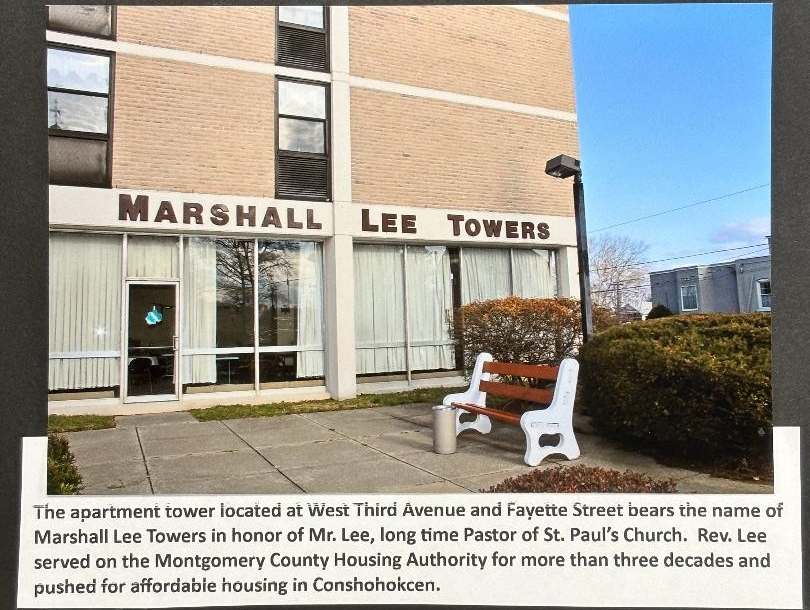
In 1973, Rev. Lee was presented with a great honor when an 80-unit high rise housing development for the elderly was constructed by the county at West Third Avenue and Fayette Street, and named in his honor, “The Marshall W. Lee Towers. The building was dedicated in March of 1974. Rev. Lee was flattered by the recognition, but took his greatest rewards to heaven in 1977, “The only thing you can take to heaven with you is the things you gave on earth,” and Rev. Lee gave plenty.
Rev. Lee did so much more than I’ve been able to write, not to mention the building of St. Paul’s Church, it was Rev. Lee who negotiated the donation of the stone from the Alan Wood Steel company used in the construction of the church.
I crossed paths with Reverend Lee just one time, I believe the year was 1975 or 1976, I said “Hello” to him but had no conversation with him. One of my small regrets in life, I wish I had those years back, I would have sat and talked with him for hours upon hours. I said at the top of this article that I believe Reverend Marshall Lee is and was the most respected man that has ever lived in Conshohocken and one of Montgomery County’s most prominent citizens that ever lived.
I personally served on dozens of committees in Conshohocken and Montgomery County over the years, I was born too late to ever serve on a committee or Board of Directors with Rev. Marshall Lee, but Boy, I would have loved that. Rev. Lee had more integrity as a community leader than anyone I have ever written about.
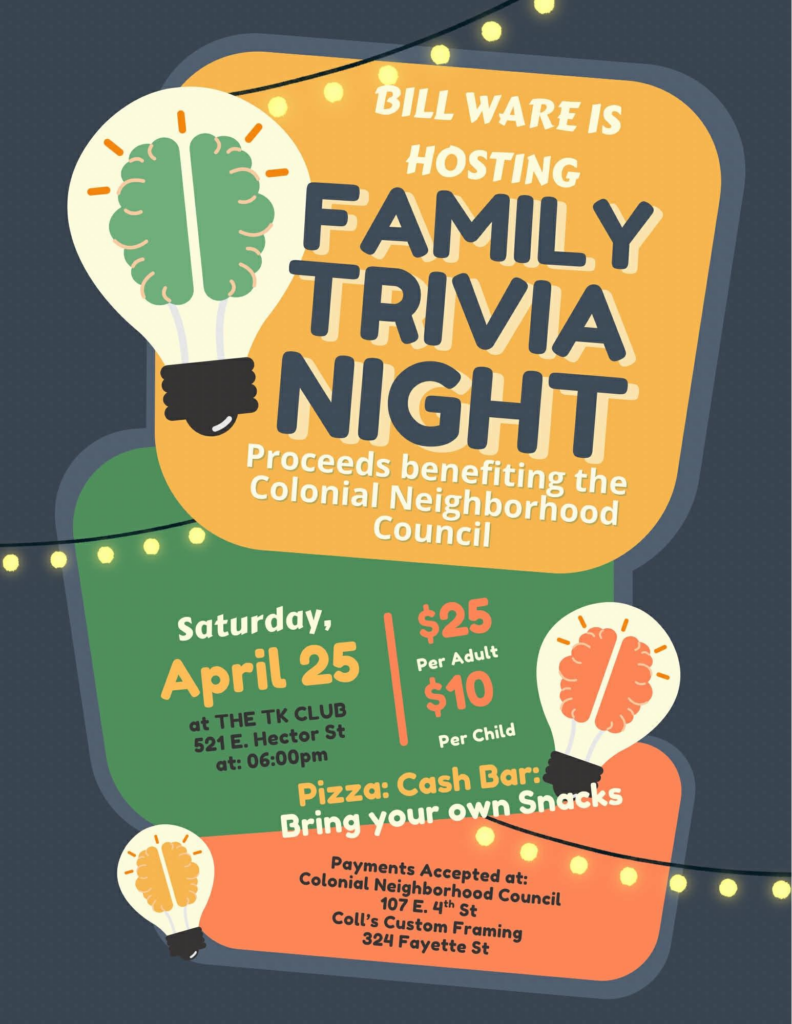
While we have you, two events that benefit our community are coming up.
The other event is the upcoming adult prom that benefits the Colonial Neighborhood Council, the Conshohocken Free Library and Colonial Education Foundation.
Conshohocken Adult Prom – Great Gatsby Tickets, Sat, Feb 28, 2026 at 7:00 PM | Eventbrite