History of a House (s) 322 & 324 Fayette Street
February 23, 2026
Sinkholes in Conshohocken are Nothing New, We Just Haven’t Had One for Awhile
April 16, 2026Saint Matthew’s Church – Right Place, Right Time
by Jack Coll and Charles J Kelly
3/24/2026
This is a special article for us. You know Jack and Brian Coll, this is a rare article where we have a special collaborator. Please enjoy this article that we would like to credit to Charles J. Kelly. This is special to Conshystuff from Saint Matthew’s Church and helping tell our community as well as our nations history.
Saint Matthew’s Church
Right Place, Right Time
By Jack Coll and Charles J. Kelly
By the time Conshohocken became a village in the early 1800’s, the former
residents, the Lenape Indians, had long been gone. In the early 1500s, a group of
Indigenous peoples known as the Lenape (Leni-Lenape) settled throughout an
unspoiled wilderness in what is now northern Delaware, New Jersey, parts of New York,
and eastern Pennsylvania, including what would become the village of Conshohocken.
It should be noted that the Lenape Indians were a peaceful Tribe that had vacated what
would become Conshohocken long before immigrants started to settle in the territory.
The early immigrant settlers of the village made their homes along the Schuylkill
River in structures primarily constructed of wood, what we might think of today as
“shacks.”
What we know as Washington Street today, running parallel with the river, was the
village’s main street. There was NO upper Conshohocken. The village was an
unsettled, raw frontier, sitting in a valley between the wooded hills of what would
become Conshohocken and West Conshohocken.
The Schuylkill Canal was constructed through the village of Conshohocken in 1824.
Alan Wood Steel, who had long had a patent on steel shovelheads, brought his
company to Conshohocken in 1832. A Post Office named Conshohocken was
established in 1836, located next to the Ford Hotel, which was located next to the
railroad that was laid out in 1837.
In 1850, when Conshohocken incorporated as a borough, the village had a mere 727
residents and very little, if any, criminal activity. Twenty years later, in 1870, the
borough’s population had swelled to 3,071, and the young borough was laying down the
foundation for becoming a major industrial town. The young iron and mill workers were
a young, rough bunch who, upon being paid on Saturday morning, in cash, found
themselves in one or more of the local taverns for an afternoon of relaxation. By early
evening, the overcrowded bars, most of them with dirt floors and spittoons, became a
crush of loud voices, rattling bottles, and the smell of stale beer.
By 1871, as the population grew, borough officials faced considerable pressure from
residents to hire a sheriff or police officer. Borough records indicate that the town paid
$50 per month for two men in 1871 and held the post until 1873. John Stemple, known
as “Jacky” and Michael Wills, who owned and operated a cigar store on Elm Street for
many years, wore civilian clothing with badges as an emblem of authority. Too often,
the two part-time officers were not taken seriously, and they were always outnumbered
on Saturday nights, which led to the hiring of a full-time police officer.
Conshohocken Borough Council honored the request of Burges William Hallowell, and
in March 1873, Jack Harrold was appointed as the borough’s first full-time policeman at
a salary of forty dollars per month.
In its early years, Conshohocken attracted immigrants because of its industry.
Conshohocken had jobs, lots of them: By 1920, the Alan Wood Steel Company was
producing better than eight percent of the nation’s steel output, which was a massive
amount for what was considered a small steel company. The history books state “small
Steel Company,” but Alan Wood employed more than 5,000 workers in 1920, pulling
workers from Conshohocken, West Conshohocken, Swedeland, Swedesburg,
Plymouth, and Norristown.
The Lee Tire and Rubber Company, as well as Walker Brothers, each employed 1200
employees. Additional jobs could be found at Quaker Chemical, C&D Batteries, Ford &
Kendig, Francis L. Freas Glass Company, Kimble Glass, Merion Worsted Mills,
Philadelphia Uniform Company, Schuylkill Iron Works, H. C. Jones Company, John
Wood Manufacturing, and dozens of other small companies.
Conshohocken Had Religion, and with that came the churches: Closely identified
with the people of Conshohocken have been their churches. Of the 727 people living in
the borough at the time of its incorporation in 1850, 658 were from Ireland. The Scotch-
Irish had already begun a Presbyterian church, using a one-story frame building on Elm
Street in 1847 as the lodge of the Sons of Temperance. (Later became Harold’s Hotel,
and in later years was Zulick’s Hotel).
The very first church built within the borough limits was constructed by members of
the Presbyterians at Elm and Maple Streets in 1848. It was enlarged in 1872. They
later built a new church on the southwest corner of Fayette Street and Third Avenue in
- In 1966, the church relocated to the Plymouth Meeting Mall and was renamed
Church on the Mall. The church building was demolished to make way for Marshall Lee
Towers.
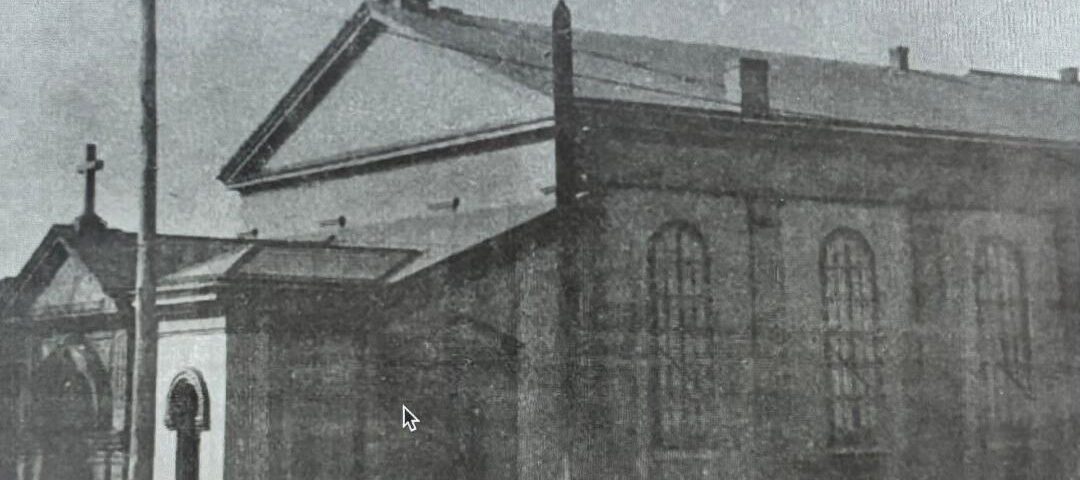
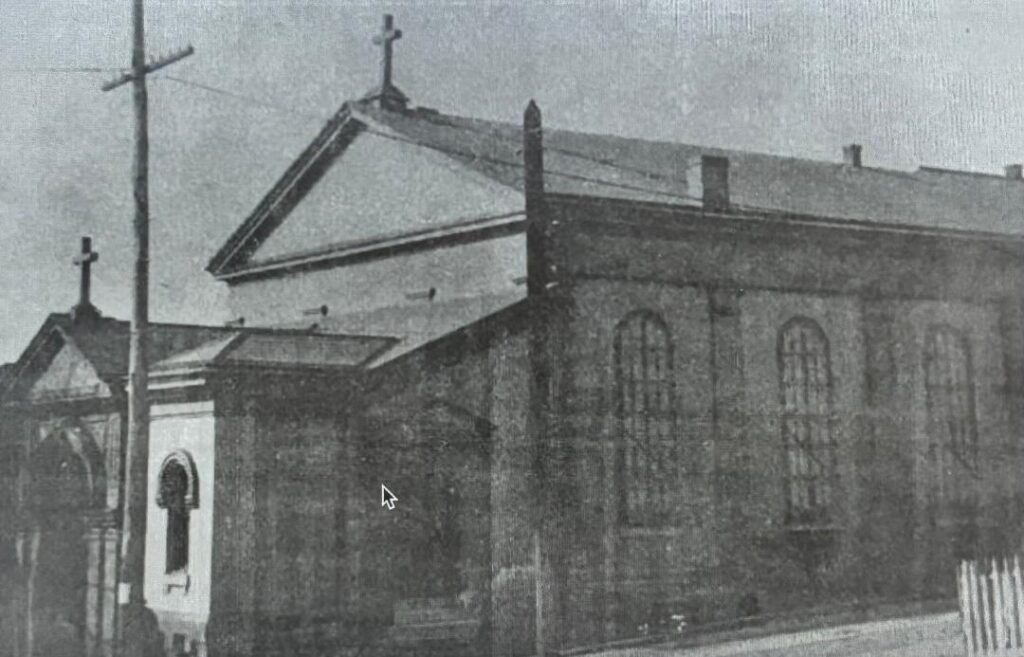
St. Matthew’s Roman Catholic Church was organized in 1851 to provide Irish
Catholics with a solid place of worship. The first church was built at Hector and Harry
Streets during the pastorate of the Reverend James McGuinness (1852-1863). After the
erection of the present church, the original church building was sold to the VFW. The
building was demolished as part of urban renewal.
St. Gertrude’s Roman Catholic Church was founded in 1888. A church was erected
at that time. The first Pastor, Reverend Daniel P. O’Connor, was appointed to the West
Conshohocken Catholic Church. The parish merged with St, Matthews in January 2016.
The building is now owned by West Conshohocken Borough.
St Mary’s Roman Catholic Church had modest beginnings but grew rapidly.
Reverend Benedict Tomiak purchased a two-story house at Oak and Elm Streets, a
house built and occupied by John Wood, the founding father of the Alan Wood Steel
Company. Rev. Tomiak celebrated St. Mary’s first mass in that house to a congregation
of sixty parishioners on May 1, 1905. The existing church building was erected in 1951.
The parish merged with St. Matthew’s in July 2014. The church is now used by the
Priestly Fraternity of St. Peter.
SS Cosmas and Damian Roman Catholic Church was founded for Italian
immigrants, the majority of whom came from the Province of Isernia. The first mass for
its parishioners was celebrated by Rev. Nicola Coscia at the former Little’s Opera House
located at First Avenue and Fayette Street. A basement church was built at the corner
of Fifth Avenue and Maple Street in 1926. In 1952, the basement church served as the
foundation for the Romanesque-style church building and remained SS Cosmas and
Damien until its merger with St. Matthew’s Church in March of 2016. The church is now
St. Mary and Mercurius Coptic Church.
According to the 1940 census, Conshohocken borough had 240 retail outlets, mostly
along the lower end of Fayette Street and along Elm and Hector Streets, including
service-industry establishments (dentists, shoe-repair stores, barbershops, etc.). That
census was conducted before World War II, as the country was emerging from the
Great Depression.
Post-war in the late 1940’s into the early 1950’s, Conshohocken’s lower-end retail
district thrived, but by the late 1950s, thousands of jobs shifted from the United States to
Japan and other overseas steel and textile outlets.
No one noticed the factories along the Conshohocken riverfront closing one by one.
In 1950, the Conshohocken population reached its peak at nearly 11,000 residents. By
the late 1950’s, stores along lower Fayette Street started closing up and leaving town.
Malls at Plymouth Meeting and King of Prussia were the cause of whitewashed
windows and plywood storefronts. Fifteen years later, as the industry declined, the
population fell to 8,000, and by the early 1970s, retail outlets had dropped dramatically,
leaving very few staples.
In late 1959, Borough leaders recognized the borough’s decline and began taking
action to prevent Conshohocken from becoming just another failed riverfront town,
depressed for decades to come. Conshohocken’s rebirth, as we see it today, has been
sixty-five years in the making.
The ripple effects of events after World War II in Conshohocken, including a job
shortage, led to a mass exodus of residents and little to no shopping in Conshohocken.
The other effects of a shrinking population were substantially fewer children in the
borough, affecting the grade schools at St. Matthew’s, SS Cosmas, St. Mary’s, and St.
Gertrude’s. Each of these schools was forced to close due to rising costs and declining
religious vocations. Discussions to close the Hervey S. Walker Elementary School (now
Conshohocken Elementary) were taking place. Were it not for the efforts of the late
Carol Ferst and others, the school may have well closed. Conshohocken High School
(located at Seventh and Fayette St) was required to close in 1966 due to a federal
mandate. St. Matthew’s High School relocated to Thirteenth and Fayette streets and
was renamed Archbishop Kennedy. As its student population declined, Kennedy High
was merged with Bishop Kenrick High School in Norristown in 1993. That school closed
on June 10, 2010, and was absorbed into Pope John Paul II High School in Royersford.
Over the decades, despite social change, St. Matthew’s Church in Conshohocken,
like a shining star, stands atop the hill at the intersection of Fayette Street and East
Third Avenue. For 175 years, through the borough’s ups and downs, St. Matthew’s
Church has been a pillar of excellence, dedicated to the worshiping residents from
throughout the Conshohocken area.
Be proud of the church you worship in!
Old Church at Hector and Harry
Thank you for reading. If you are free on April 25th, Conshystuff is hosting a family trivia at the TK Club to support the Colonial Neighborhood Council. Tickets are $25 per adult and $10 per child. Sign up at Coll’s Custom Framing.